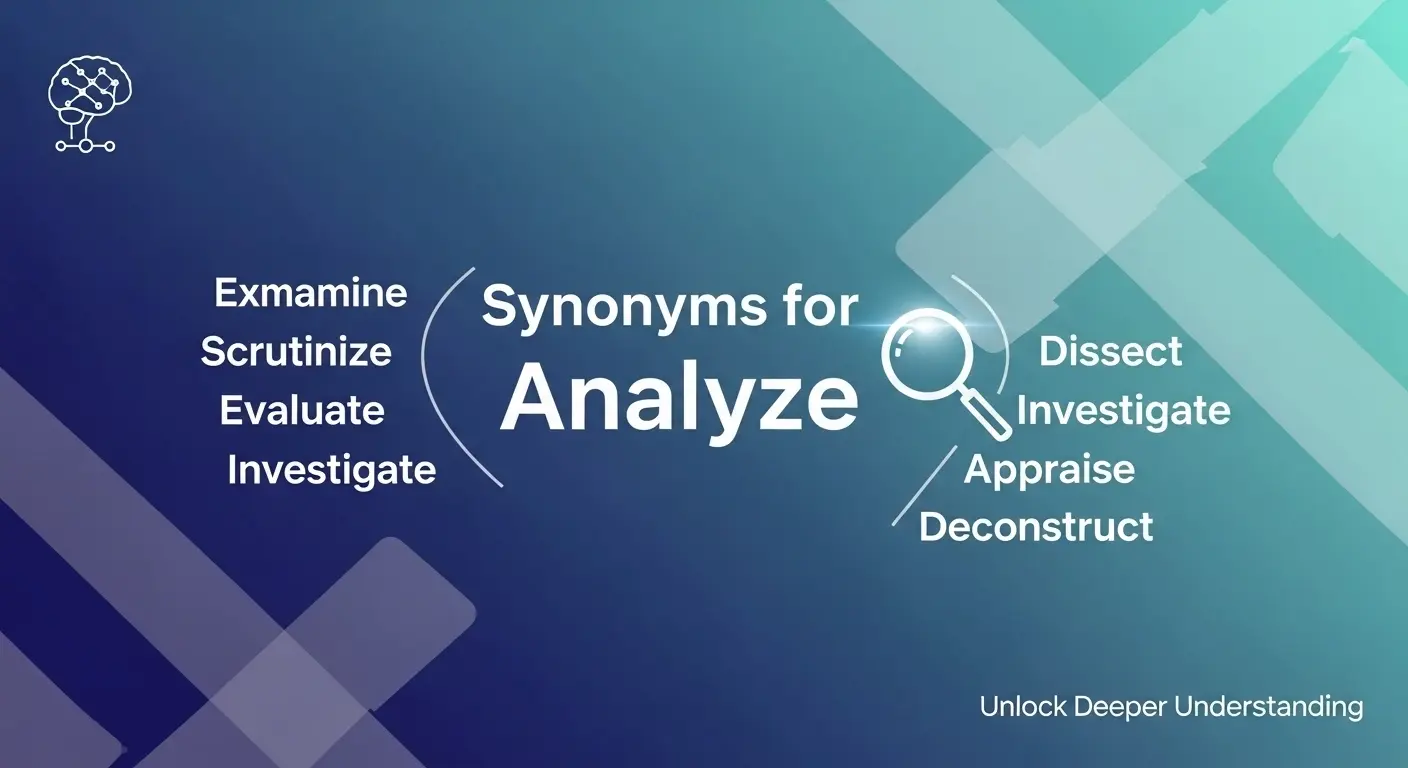
Have you ever read something and tried to understand it deeply? Maybe you looked at exam questions or checked your website data. That is when you analyze.
To analyze means to look at something carefully and break it into parts. You do this to understand it better. For example, a student may analyze a story to find its meaning. A blogger may analyze traffic to grow a site.
Learning synonyms for analyze helps you speak and write better. It gives you more word choices. This is useful for students, bloggers, content writers, and anyone who uses English daily. Simple words can make your message clear and strong.
MAIN CONTENT SYNONYMS LIST (50 Words)
1. Examine
Meaning: To look at something very carefully.
Examples:
- I examine my notes before the test.
- She examines the report for mistakes.
2. Study
Meaning: To spend time learning something.
Examples:
- I study this topic every day.
- He studies the chart closely.
3. Inspect
Meaning: To check something for problems.
Examples:
- They inspect the car before buying.
- She inspects her work twice.
4. Review
Meaning: To look again at something.
Examples:
- I review my answers.
- He reviews the blog post.
5. Evaluate
Meaning: To judge the value or quality.
Examples:
- Teachers evaluate students.
- I evaluate my progress weekly.
6. Assess
Meaning: To check and decide the level.
Examples:
- The doctor assesses the patient.
- She assesses the risk.
7. Investigate
Meaning: To find out the truth.
Examples:
- Police investigate the case.
- He investigates the issue.
8. Explore
Meaning: To look into something new.
Examples:
- I explore new ideas.
- She explores the topic deeply.
9. Break down
Meaning: To divide into small parts.
Examples:
- I break down the lesson.
- He breaks down the problem.
10. Interpret
Meaning: To explain the meaning.
Examples:
- I interpret the poem.
- She interprets the data.
11. Understand
Meaning: To know the meaning.
Examples:
- I understand this lesson.
- He understands the idea.
12. Probe
Meaning: To ask deeply.
Examples:
- The teacher probes students.
- He probes for answers.
13. Check
Meaning: To look to be sure.
Examples:
- I check my email.
- She checks the list.
14. Scrutinize
Meaning: To look very closely.
Examples:
- He scrutinizes details.
- I scrutinize the contract.
15. Dissect
Meaning: To cut into parts to study.
Examples:
- We dissect the text.
- She dissects the idea.
16. Test
Meaning: To try something to see results.
Examples:
- I test this method.
- He tests the system.
17. Audit
Meaning: To check records.
Examples:
- They audit the accounts.
- She audits the files.
18. Compare
Meaning: To see differences.
Examples:
- I compare two phones.
- He compares results.
19. Contrast
Meaning: To show differences clearly.
Examples:
- I contrast both ideas.
- She contrasts colors.
20. Observe
Meaning: To watch carefully.
Examples:
- I observe people.
- He observes behavior.
21. Question
Meaning: To ask why or how.
Examples:
- I question the result.
- She questions the data.
22. Decode
Meaning: To understand hidden meaning.
Examples:
- I decode the message.
- He decodes signals.
23. Calculate
Meaning: To work with numbers.
Examples:
- I calculate costs.
- She calculates profit.
24. Diagnose
Meaning: To find a problem.
Examples:
- Doctors diagnose illness.
- He diagnoses errors.
25. Gauge
Meaning: To measure roughly.
Examples:
- I gauge interest.
- She gauges reactions.
26. Measure
Meaning: To find size or amount.
Examples:
- I measure length.
- He measures success.
27. Research
Meaning: To study deeply.
Examples:
- I research topics.
- She researches trends.
28. Deconstruct
Meaning: To break into parts.
Examples:
- I deconstruct ideas.
- He deconstructs text.
29. Read into
Meaning: To find deeper meaning.
Examples:
- I read into words.
- She reads into actions.
30. Think through
Meaning: To think step by step.
Examples:
- I think through plans.
- He thinks through choices.
31. Look into
Meaning: To check something.
Examples:
- I look into this issue.
- She looks into details.
32. Dig into
Meaning: To study deeply.
Examples:
- I dig into data.
- He digs into facts.
33. Go over
Meaning: To review again.
Examples:
- I go over notes.
- She goes over plans.
34. Map out
Meaning: To plan step by step.
Examples:
- I map out ideas.
- He maps out tasks.
35. Outline
Meaning: To show main points.
Examples:
- I outline my essay.
- She outlines steps.
36. Clarify
Meaning: To make clear.
Examples:
- I clarify my point.
- He clarifies doubts.
37. Verify
Meaning: To check if true.
Examples:
- I verify facts.
- She verifies data.
38. Validate
Meaning: To prove correct.
Examples:
- I validate results.
- He validates ideas.
39. Break apart
Meaning: To split into pieces.
Examples:
- I break apart problems.
- She breaks apart tasks.
40. Sort out
Meaning: To organize and fix.
Examples:
- I sort out issues.
- He sorts out files.
41. Process
Meaning: To deal step by step.
Examples:
- I process data.
- She processes orders.
42. Reflect on
Meaning: To think deeply.
Examples:
- I reflect on mistakes.
- He reflects on actions.
43. Examine closely
Meaning: To look very carefully.
Examples:
- I examine closely details.
- She examines closely errors.
44. Check over
Meaning: To review quickly.
Examples:
- I check over work.
- He checks over notes.
45. Review deeply
Meaning: To study again with care.
Examples:
- I review deeply lessons.
- She reviews deeply topics.
46. Break into parts
Meaning: To divide clearly.
Examples:
- I break into parts ideas.
- He breaks into parts tasks.
47. Examine in detail
Meaning: To look very carefully.
Examples:
- I examine in detail data.
- She examines in detail reports.
48. Study closely
Meaning: To look with focus.
Examples:
- I study closely charts.
- He studies closely patterns.
49. Think about
Meaning: To consider something.
Examples:
- I think about this idea.
- She thinks about choices.
50. Look closely
Meaning: To watch carefully.
Examples:
- I look closely at details.
- He looks closely at numbers.
Conclusion
Learning synonyms for analyze can make your English much stronger. It helps you write better blogs, clear essays, and smart emails. When you use different words, your content sounds fresh and natural. These words also help in speaking. You can explain ideas more clearly in daily conversations. Students can improve exams, and writers can create better content.
Try to use these synonyms in real life. Use them in emails, school work, and chats. Practice a little every day. Soon, you will feel more confident using English in any situation.

I am Hunter James is the lead content writer and language researcher at Englexa.com. He specializes in English vocabulary, synonyms, grammar explanations, and easy-to-understand language guides. With a passion for simplifying complex words and expressions, Hunter helps readers expand their vocabulary and improve their writing skills.