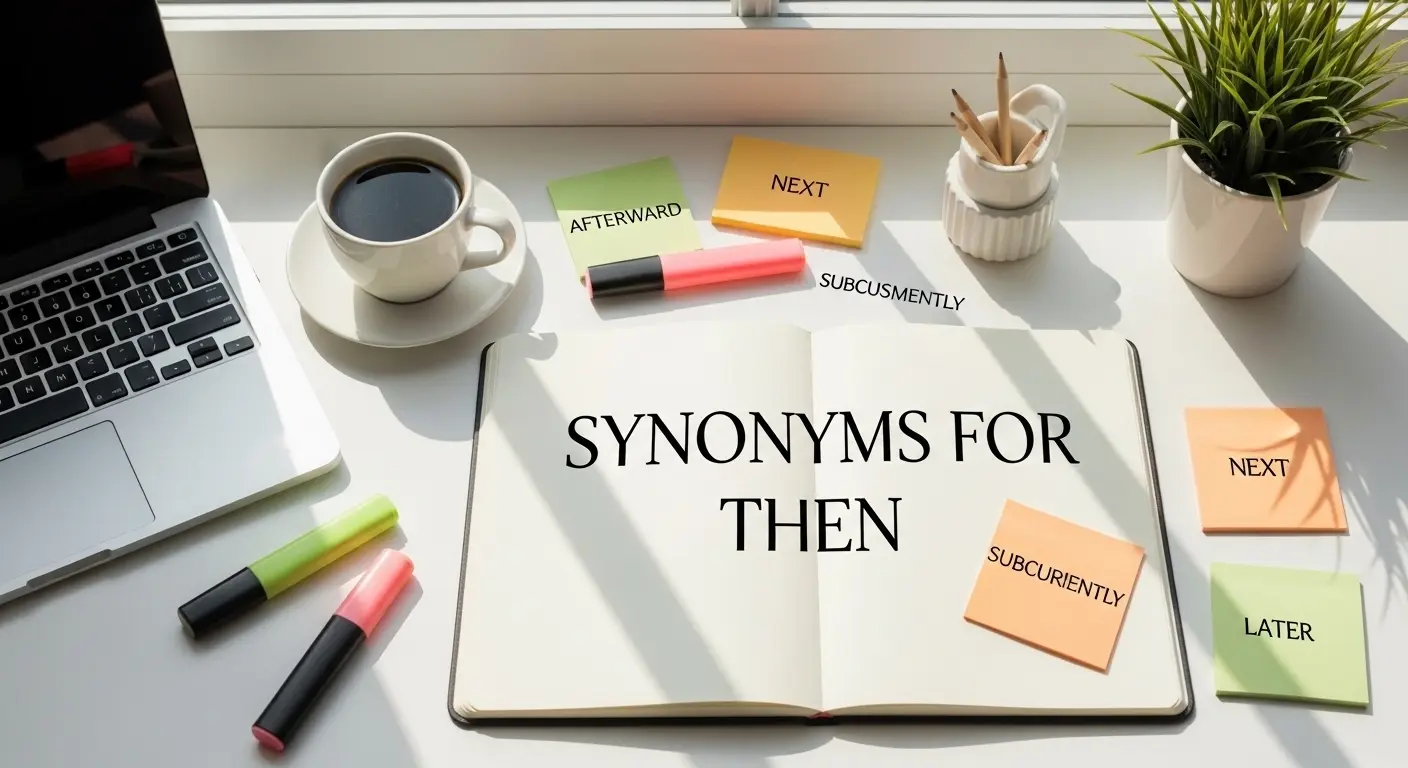
Have you ever found yourself writing or speaking and thinking, “I wish I had a better word than ‘then’”? Maybe you are a student, blogger, or content writer trying to make your sentences sound fresh and natural.
The word “then” is simple, but it shows time or order in a sentence. For example: “I ate breakfast, then I went to school.” It helps connect actions and events.
Learning synonyms for them can make your writing more lively, interesting, and clear. Whether you are writing an essay, blog, or just chatting in English, these alternatives will help you sound smarter and more confident.
Let’s explore 50 easy-to-use synonyms that you can start using today!
1. Afterwards
Meaning: Something that happens after another event.
Examples:
- I finished my homework. Afterwards, I watched TV.
- We had lunch. Afterwards, we went to the park.
2. Next
Meaning: The thing that comes immediately after.
Examples:
- I cleaned my room. Next, I did my laundry.
- She read a book. Next, she went for a walk.
3. Subsequently
Meaning: Happening after something else.
Examples:
- He fell sick. Subsequently, he stayed home.
- I missed the bus. Subsequently, I was late.
4. Thereafter
Meaning: After that time.
Examples:
- She graduated. Thereafter, she traveled abroad.
- I signed the contract. Thereafter, the work started.
5. Later
Meaning: At a time after now or after an event.
Examples:
- I will call you later.
- We had coffee, and later, we went shopping.
6. Eventually
Meaning: At the end of a process or period.
Examples:
- He practiced a lot. Eventually, he won the match.
- I tried many recipes. Eventually, I found the best one.
7. Following
Meaning: After something happens.
Examples:
- Following the meeting, we went for lunch.
- I got the email. Following that, I replied quickly.
8. Thereupon
Meaning: Immediately after that event.
Examples:
- She finished her speech. Thereupon, the audience clapped.
- He made a suggestion. Thereupon, we agreed.
9. In turn
Meaning: As a result or next in order.
Examples:
- She helped me. In turn, I helped her.
- Each student answered, in turn, the teacher’s questions.
10. Henceforth
Meaning: From this time on.
Examples:
- Henceforth, I will study daily.
- The company announced that henceforth, all meetings are online.
11. Afterwards
Meaning: After something has happened.
Examples:
- I had breakfast. Afterwards, I went to school.
- We watched a movie. Afterwards, we went for ice cream.
12. Shortly after
Meaning: Soon after an event.
Examples:
- He left the house. Shortly after, it started raining.
- The show ended. Shortly after, we went home.
13. Ultimately
Meaning: In the end or finally.
Examples:
- We discussed a lot. Ultimately, we decided to wait.
- She tried many jobs. Ultimately, she became a teacher.
14. Then again
Meaning: On the other hand, considering something else.
Examples:
- I might go to the party. Then again, I might stay home.
- He seems tired. Then again, he did sleep well.
15. In succession
Meaning: One after another.
Examples:
- The runners finished in succession.
- We spoke to the guests in succession.
16. Sequentially
Meaning: Following a certain order.
Examples:
- The steps are done sequentially.
- He answered the questions sequentially.
17. In chronological order
Meaning: In the order that events happened.
Examples:
- We listed the events in chronological order.
- Please arrange the photos in chronological order.
18. Momentarily
Meaning: Very soon after.
Examples:
- I will help you momentarily.
- The train will arrive momentarily.
19. After a while
Meaning: After some time.
Examples:
- After a while, the rain stopped.
- I waited. After a while, she came back.
20. Down the line
Meaning: Later in time.
Examples:
- We will decide down the line.
- Something important will happen down the line.
21. In the aftermath
Meaning: After an important event.
Examples:
- In the aftermath of the storm, the city cleaned up.
- In the aftermath of the meeting, we discussed plans.
22. As a result
Meaning: Something that happens because of an earlier event.
Examples:
- He didn’t study. As a result, he failed.
- It rained a lot. As a result, the picnic was canceled.
23. Hence
Meaning: For that reason, after that.
Examples:
- He forgot the map. Hence, we got lost.
- She worked hard. Hence, she succeeded.
24. Consecutively
Meaning: One after another without pause.
Examples:
- He won three games consecutively.
- The events occurred consecutively.
25. In sequence
Meaning: Following a proper order.
Examples:
- The instructions are written in sequence.
- The dancers moved in sequence.
26. Thereafter
Meaning: After that time.
Examples:
- She finished school. Thereafter, she started working.
- We met in the morning. Thereafter, we went shopping.
27. In due course
Meaning: At the right time later.
Examples:
- You will receive a reply in due course.
- The results will be announced in due course.
28. At that time
Meaning: When an event happened.
Examples:
- At that time, I was reading.
- He was very young at that time.
29. Following that
Meaning: After the event mentioned.
Examples:
- I cleaned the kitchen. Following that, I washed the dishes.
- She spoke to the manager. Following that, she left.
30. Later on
Meaning: After some time.
Examples:
- We had lunch. Later on, we went to the park.
- He studied first. Later on, he played games.
31. In the end
Meaning: Finally, after everything.
Examples:
- In the end, they agreed.
- I tried many times. In the end, I succeeded.
32. Hereafter
Meaning: From now on or after this.
Examples:
- Hereafter, we will follow new rules.
- She decided that afterwards, she would wake up early.
33. In the long run
Meaning: After a long time or eventually.
Examples:
- In the long run, exercise helps health.
- It was hard at first, but in the long run, it worked.
34. In progression
Meaning: Moving forward step by step.
Examples:
- The numbers increased in progression.
- The students spoke in progression.
35. One after another
Meaning: Happening in order without gaps.
Examples:
- The cars passed one after another.
- They answered one after another.
36. In the future
Meaning: After now, later in time.
Examples:
- In the future, we will travel more.
- She promised to call in the future.
37. By and by
Meaning: After a short time.
Examples:
- By and by, the sun appeared.
- He will arrive, by and by.
38. At a later time
Meaning: Happening after now.
Examples:
- We will discuss it at a later time.
- I will help you at a later time.
39. In aftertime
Meaning: After some event or time.
Examples:
- In the afternoon, we realized our mistake.
- The building was rebuilt in aftertime.
40. Over time
Meaning: Gradually after some time.
Examples:
- Over time, he learned English.
- The garden grew beautiful over time.
41. In succession
Meaning: One after another in order.
Examples:
- The students answered in succession.
- The events happened in succession.
42. In retrospect
Meaning: Thinking back after the event.
Examples:
- In retrospect, I should have studied more.
- In retrospect, it was a good decision.
43. Sequentially
Meaning: Following a clear order.
Examples:
- The steps are done sequentially.
- The files are numbered sequentially.
44. Subsequently
Meaning: After something else.
Examples:
- He got sick. Subsequently, he stayed home.
- I lost my keys. Subsequently, I was late.
45. Then and there
Meaning: Immediately at that moment.
Examples:
- He signed the contract then and there.
- I decided then and there to help her.
46. Afterward
Meaning: Later, after an event.
Examples:
- We had a meeting. Afterward, we went for lunch.
- She read the email. Afterward, she replied.
47. Henceforward
Meaning: From now on.
Examples:
- Henceforward, all letters will be emailed.
- She decided henceforth to wake up early.
48. In the meanwhile
Meaning: During the time before something happens.
Examples:
- The movie will start in an hour. In the meantime, we had coffee.
- I cooked dinner. In the meanwhile, he set the table.
49. In sequence
Meaning: Following a correct order.
Examples:
- The tasks were done in sequence.
- Please answer the questions in sequence.
50. In the interim
Meaning: During the time between events.
Examples:
- In the interim, we can rest.
- The repairs will take a week. In the interim, we stayed elsewhere.
Conclusion
Learning synonyms for them can make your writing, speaking, and blogging more interesting. Using these words helps you connect ideas clearly and sound natural. Students, writers, and daily English users can improve communication by practicing these synonyms in emails, essays, stories, and casual conversations. Start adding them to your sentences today, and see how your English becomes more lively, fluent, and engaging. Remember, small changes like swapping them with another word can make a big difference!

I am Miles Carter is the lead content creator and language enthusiast behind Englexa.com. With a strong passion for English vocabulary, grammar, and word exploration, Miles helps readers discover clearer ways to express themselves